If your goal is to improve your actual Shogi strength, I do not recommend relying mainly on ultra-short games such as 3-minute blitz or 10-second-per-move formats.
I enjoy short-time games too, and I have played many of them. But from my own experience, short games are better for entertainment than for steady long-term growth.
Recommendation First
If possible, choose games with at least a 10-minute time control.
That gives you enough time to:
- search for better candidate moves,
- compare multiple lines,
- and make decisions you can review later.
4 Problems with Short-Time Shogi
1. You Stop Chasing the Best Move
In blitz games, "play a decent move quickly" often beats "find the best move." That skill is useful for blitz itself, but it can weaken your habit of deep calculation in difficult positions.
Over time, your thinking may shift toward only moves you can play instantly, and your improvement can stall.
2. Wins and Losses Become Superficial
Short games are frequently decided by time trouble or simple blunders. As a result, conclusions become shallow:
- "I flagged."
- "I blundered."
It becomes harder to evaluate whether your strategic decisions were actually good.
3. Lessons Do Not Stick as Well
Longer games force you to struggle with positions for real. That process builds stronger memory and better pattern recognition.
By contrast, moves played on instinct in fast games are often forgotten quickly, and the same mistakes repeat.
4. The Pace Discourages Review
When the tempo is fast, it is easy to click into the next game immediately. That habit cuts out one of the strongest training methods: post-game analysis.
Why Post-Game Analysis Matters (Kansousen)
Serious improvement comes from the cycle:
- Think deeply during the game.
- Review deeply after the game.
When reviewing, use AI analysis or stronger players' feedback and focus on:
- Turning points where the evaluation dropped sharply
- Positions where you spent a lot of time and felt uncertain
- Repeating habits in your own thinking, such as over-attacking or over-defending
This is where you convert one game into lasting skill.
It also helps to write down what you learned so you can look back on it later. I made a free tool, Shogi Review Notes, for exactly this: paste a game record, leave comments on key positions, and turn it into a review article with board diagrams.
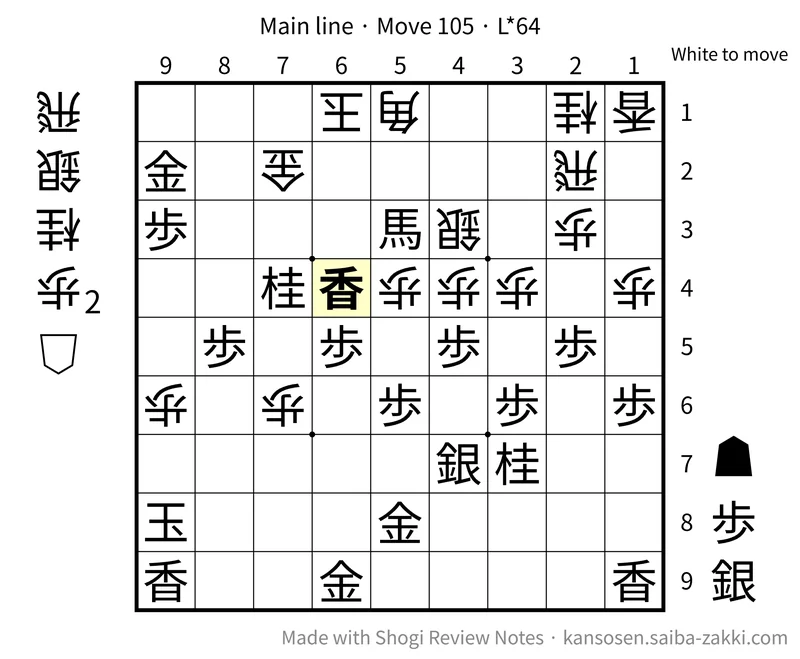
Shogi Review Notes
A free tool for writing illustrated game reviews. No sign-up, and your games and comments are never uploaded.
kansosen.saiba-zakki.com
Practical Time-Control Suggestion
For improvement-focused sessions, prioritize 10-minute games or longer. Use short-time games as a separate mode for fun, warm-up, or quick play.
Summary
Short-time Shogi is exciting, but if your goal is true improvement, deeper thinking plus review is more effective.
Use this loop consistently:
- Play seriously
- Review seriously
- Correct one weakness at a time
That is the most reliable way to get stronger.
For book details, see Shogi Beyond the Rules.
Thank you for reading.
